At first glance NGC 3077 looks like a typical, relatively peaceful elliptical galaxy. However, as this NASA/ESA Hubble Space Telescope image dramatically reveals it is actually a hotbed of very energetic star formation and the whole galaxy is laced with dusty tendrils. It lies about 13 million light-years from Earth.
NGC 3077 was first seen by William Herschel with his 47 cm telescope in England in 1801, when he was close to completing his sky surveys. It is located in the far northern sky in the constellation of Ursa Major (the Great Bear) and forms a triplet with two brighter nearby galaxies, the graceful spiral Messier 81 and the very peculiar and active starburst galaxy Messier 82.
Although overshadowed by its brighter neighbours, NGC 3077 is also very active and resembles a less dramatic version of Messier 82. Interactions between the three galaxies have stoked the fires of star formation in the core of the galaxy and the brilliant glow of many huge young star clusters at the centre of NGC 3077 dominates the Hubble image. If you look closely you can see vast numbers of individual stars in the galaxy across the entire image, as well as several, much more remote, galaxies seen through the much closer NGC 3077.
This picture was created from images taken using the Wide Field Channel on Hubble’s Advanced Camera for Surveys. It was made from images through blue (F475W, coloured blue), orange (F606W, coloured green) and near-infrared (F814W, coloured red) filters. The exposure times were about 27 minutes per filter. The field of view extends over about 3.3 arcminutes.
Credit:
ESA/Hubble & NASA
PEACE JUSTICE CREATION CONNECTION IMAGINATION MAGIC HEALING RESTORATION RESURRECTION REFLECTION SUNFLOWER TOWER TREE OF LIFE SECRET STAR STATION RAINBOW BRIDGE WIZARD SPIRAL STAIRWAY AIR SPIRIT WATER EARTH SILVER LUCID DREAM ASTRAL TAROT MANDALA COSMIC FANTASY WORLD TREE LIBRARY LABYRINTH TEMPLE BLUE HOLY FORTRESS SAPPHIRE AMETHYST SKYCASTLE RIVER INN THEATER CELESTIAL MEMORY PALACE GALAXY HOME MULTIVERSE FRACTAL MULTIDIMENSIONAL ANCIENT LOVE UNDERSTANDING CONSCIOUSNESS EMERALD BUTTERFLY REALM
Search This Blog
Wednesday, November 3, 2010
A Deceptively Quiet Galaxy | ESA/Hubble Space Telescope Picture Of The Week - November 1, 2010
Saturday, October 30, 2010
A Great Ball Of Stars - Hubble Space Telescope Picture Of The Week - October 25, 2010
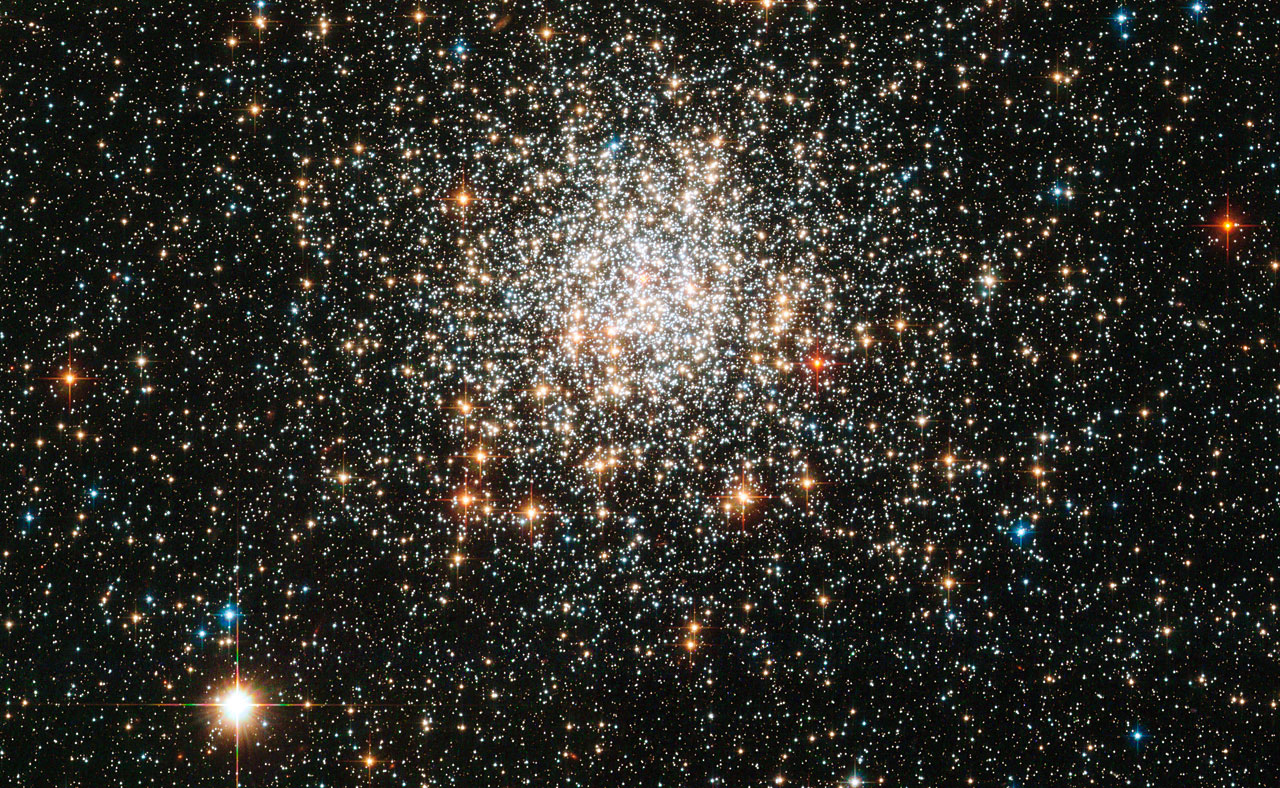
The NASA/ESA Hubble Space Telescope has turned its sharp eye towards a tight collection of stars, first seen 174 years ago. The result is a sparkling image of NGC 1806, tens of thousands of stars gravitationally bound into a rich cluster. Commonly called globular clusters, most of these objects are very old, having formed in the distant past when the Universe was only a fraction of its current age. NGC 1806 lies within the Large Magellanic Cloud, a satellite galaxy of our own Milky Way. It can be observed within the constellation of Dorado (the dolphin-fish), an area of the sky best seen from the Earth’s southern hemisphere.
NGC 1806 was discovered in 1836 by the British astronomer John Herschel. He had travelled to South Africa in order to catalogue astronomical objects visible best from southern latitudes, and thereby complete work begun by his father William, the man who coined the term “globular cluster”. Using a large telescope John Herschel carefully scanned the night sky and noted objects of interest, of which NGC 1806 was one. In the same year that he documented NGC 1806 he was visited by the naturalist Charles Darwin after the HMS Beagle stopped over in Cape Town. Darwin later referred to John Herschel as “one of our greatest philosophers”.
The Wide Field Channel of Hubble's Advanced Camera for Surveys was used to obtain this picture that was created from images taken through blue (F435W, coloured blue), yellow (F555W, coloured green) and near-infrared (F814W, coloured red) filters. The exposure times were 770 s, 720 s and 688 s, respectively, and the field of view is 3.1 by 1.9 arcminutes. Surely Herschel, who made great contributions to the sciences of both astronomy and photography, would have been immensely impressed by this glittering Hubble picture
Credit:
ESA/Hubble & NASA
Saturday, October 23, 2010
An Odd Planetary Nebula In Hercules | ESA/Hubble - Picture Of The Week
For as long as there been humans we have searched for our place in the cosmos. Where are we? Who are we? We find that we live on an insignificant planet of a hum-drum star lost in a galaxy tucked away in some forgotten corner of a universe in which there are far more galaxies than people. This perspective is a courageous continuation of our penchant for constructing and testing mental models of the skies; the Sun as a red-hot stone, the stars as a celestial flame, the Galaxy as the backbone of night.
- Carl Sagan, Cosmos
The NASA/ESA Hubble Space Telescope has taken a striking high resolution image of the curious planetary nebula NGC 6210. Located about 6500 light-years away, in the constellation of Hercules, NGC 6210 was discovered in 1825 by the German astronomer Friedrich Georg Wilhelm Struve. Although in a small telescope it appears only as a tiny disc, it is fairly bright.
NGC 6210 is the last gasp of a star slightly less massive than our Sun at the final stage of its life cycle. The multiple shells of material ejected by the dying star form a superposition of structures with different degrees of symmetry, giving NGC 6210 its odd shape. This sharp image shows the inner region of this planetary nebula in unprecedented detail, where the central star is surrounded by a thin, bluish bubble that reveals a delicate filamentary structure. This bubble is superposed onto an asymmetric, reddish gas formation where holes, filaments and pillars are clearly visible.
The life of a star ends when the fuel available to its thermonuclear engine runs out. The estimated lifetime for a Sun-like star is some ten billion years. When the star is about to expire, it becomes unstable and ejects its outer layers, forming a planetary nebula and leaving behind a tiny, but very hot, remnant, known as white dwarf. This compact object, here visible at the centre of the image, cools down and fades very slowly. Stellar evolution theory predicts that our Sun will experience the same fate as NGC 6210 in about five billion years.
This picture was created from images taken with Hubble’s Wide Field Planetary Camera 2 through three filters: the broadband filter F555W (yellow) and the narrowband filters F656N (ionised hydrogen), F658N (ionised nitrogen) and F502N (ionised oxygen). The exposure times were 80 s, 140 s, 800 s and 700 s respectively and the field of view is only about 28 arcseconds across.
Credit:
ESA/Hubble and NASA